


This post is the first in a two-part series.
Socialists have long criticized capitalism for failing to meet the basic needs of the many while allowing a select few to amass unimaginable riches. But the socialist left’s traditional complaint is not just that capitalism produces poverty in the midst of plenty. It is also that the plenty enjoyed by the few is produced by way of the poverty of the many: that capitalists earn their riches by exploiting workers, paying them less than the full value of what they produce.
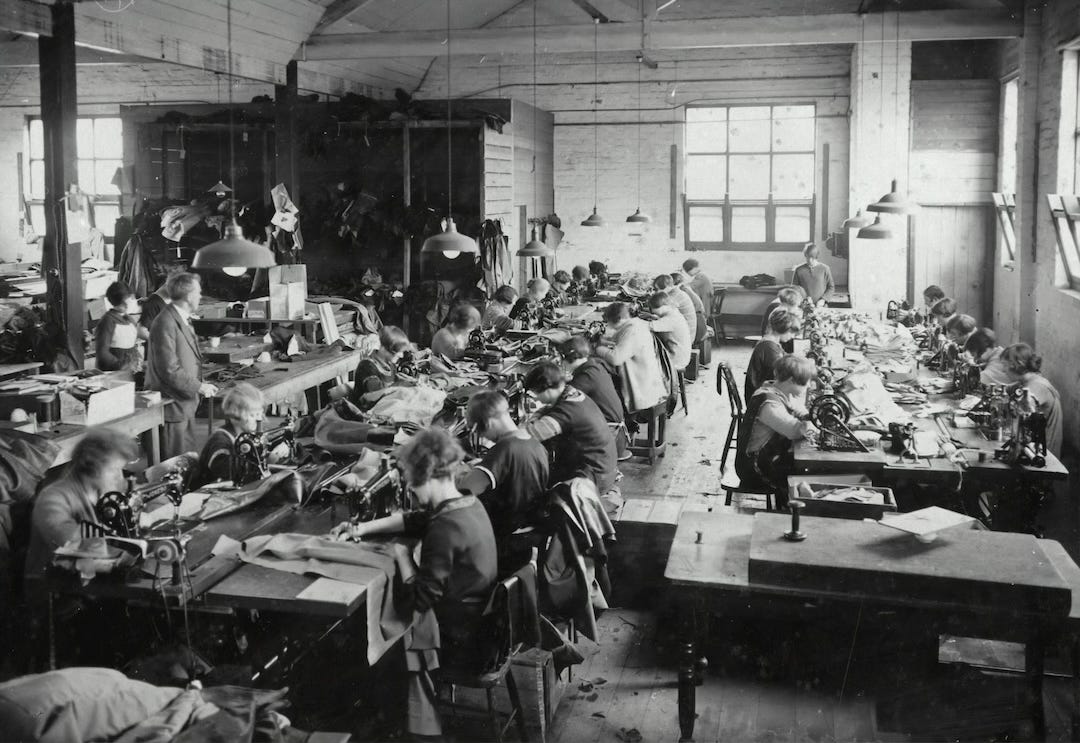
I think most of us on the Left have an intuitive understanding of capitalist exploitation. Workers sell their labor to capitalists for a wage; workers then produce goods and services for capitalists, who in turn sell those products on the market and keep a share of the revenue as profits. Despite the fact that it is the workers who actually make the products, the capitalists — simply by virtue of their ownership of means of production — reap most of the rewards from those products.1 In this way, the capitalists are able to take “untold millions that they never toiled to earn,” as the old labor anthem “Solidarity Forever” puts it.
We can see this idea as reflecting a more general definition of exploitation, which can apply in settings besides those involving employers and employees. A first pass at a more general definition might go something like: Person A benefits from Person B’s uncompensated labor.2
But this can’t be the full story. After all, children usually benefit from their parents’ uncompensated labor. And most governments appropriate some of the value of what workers produce through income taxes, which are then used to fund public services as well as welfare benefits for nonworkers — meaning nonworkers benefit at the expense of workers. But we wouldn’t say these are cases of exploitation.
So, “Person A benefits from Person B’s uncompensated labor” is a necessary component of a definition of exploitation, but it isn’t sufficient on its own. A full definition of exploitation needs to go further to explain when exactly benefiting from another’s uncompensated labor is unjust and why. Such a definition will allow us to explain what it means to say that capitalists exploit workers.
The questions of what exploitation is and what makes capitalism exploitative were the subject of spirited debate among analytical philosophers in the 1980s, largely driven by the work of G. A. Cohen and of economist and political scientist John Roemer.3 Though it petered out somewhat in the 1990s and 2000s, that debate has experienced something of a revival in the last fifteen years or so.4
The following is my sense of the current “state of play” in this debate, which I put together while trying to formulate my own views on the subject. I offer it as a summary for those on the Left who might be interested in probing a little bit underneath our traditional slogans about exploitation. And I’m interested in feedback both from those new to the debate and those who have thought about this before: What’s your take? And what do you think I’m missing so far?
The Force View
What, precisely, is unjust about how capitalists benefit from their workers’ labor? One natural thought, with a basis in Marx’s own writings, is that workers are forced into providing uncompensated labor for capitalists. More precisely: because they lack independent means of subsistence, workers must sell their labor to capitalists in order to survive. That desperation is what allows capitalists to keep part of the revenue workers produce as profit — the capitalist’s offer is one that workers simply can’t refuse.
This line of thought suggests the view that what makes capitalism exploitative is that one party (capitalists) forcibly or coercively extracts uncompensated labor from the other party (workers). Call this the Force View.
The Force View is, as stated here, a nonstarter. Again, governments regularly tax workers in order to provide benefits to the nonworking population — and they do so coercively, by threatening tax delinquents with fines or jail time. According to the Force View, this sort of forcible redistribution would be unjust. This is in fact the argument that libertarians make all the time, but it’s not a conclusion socialists should be willing to accept. Therefore, the fact that A benefits from B’s uncompensated labor, and that labor is forced, isn’t sufficient on its own to define exploitation. We’d need to go further to identify whether the force being used is legitimate or not.
Moreover, it also seems possible for exploitation to occur in the absence of force. Even under capitalism, a generous welfare state might provide people with a comfortable-enough existence that they are not literally forced to work — welfare benefits might be sufficient to give people a reasonable or acceptable alternative to working. Yet those who do choose to work may nevertheless find themselves employed by a capitalist, who benefits from the workers’ uncompensated labor. Why couldn’t that still be exploitative?
For these reasons, the Force View today does not have many takers among philosophers.
The Distributive Injustice View
The most prominent account of exploitation, endorsed in different guises by Cohen, Roemer, and the philosopher Richard Arneson, is the Distributive Injustice View. This view says, roughly, that exploitation occurs when 1) person A benefits from person B’s uncompensated labor and 2) this is the result of an unjustifiable inequality in the distribution of means of production. Capitalists, because they have an unjust monopoly over the means of production, are able to extract uncompensated labor from workers — regardless of whether those workers are desperate (the scenario the Force View imagines).
Those who hold this view endorse some version of a principle of equal opportunity: People deserve a genuinely equal shot at acquiring the means to live a flourishing life, crucially including income and leisure time. Capitalists, who have generally acquired control over means of production through plunder and sheer luck (most commonly through inheritance), are massively, unfairly advantaged in comparison with workers in their ability to secure a good income and plenty of leisure time. And this injustice in the distribution of the means of production makes it exploitative for capitalists to turn around and use the means of production they control to benefit from workers’ uncompensated labor.
The Distributive Injustice View avoids the problems faced by the Force View. The Distributive Injustice View does not imply that disabled welfare recipients exploit the workers who are taxed to pay for their benefits, since this sort of redistribution is not the result of an unjust distribution of assets. Nor does the Distributive Injustice View imply that capitalist exploitation is impossible with a generous welfare state. As long as capitalists’ unjust ownership — and workers’ unjust lack — of means of production enables capitalists to extract uncompensated labor from workers, we have exploitation.
But this account also has its own problems. First, it is questionable whether prior distributive injustice is actually necessary for exploitation. This worry comes up in discussions of “cleanly generated capitalism.” We can imagine a society where the means of production are initially distributed fairly — perhaps everyone is allocated equal shares of society’s capital stock, or all capital is collectively owned — people might, through a series of fully informed and voluntary transactions, end up in a situation where some possess more capital and can begin to hire and exploit others as workers again.
Imagine the following scenario proposed by Robert Nozick:
Capitalism Reborn: A left-wing government takes power and brings all companies under public ownership. Not long after the revolution, I start melting down some of my personal possessions and build a machine out of the material. I offer my friends and neighbors a philosophy lecture once a week in exchange for working the machine, whose products I exchange for other items. (The raw materials used by the machine are given to me by others, also in exchange for my lectures.) Similar activities by others across the economy lead to the reemergence of a large private sector in which owners of means of production hire nonowners to work for them.5
So, despite starting with a distribution of means of production that socialists would think is just, we may return to a situation with capitalist exploitation. But the Distributive Injustice View could not condemn that situation as exploitative, since all the individual transactions that got us to that point were freely undertaken by consenting adults who started off on an equal footing in terms of the distribution of means of production.
Here’s a possible explanation of why, contrary to the Distributive Injustice View, “cleanly generated” capitalism is exploitative. It seems possible for 1) some person A to enrich himself at the expense of another person B 2) by taking advantage of some vulnerability of B’s 3) even when that vulnerability is not due to a prior distributive injustice. Philosophers tend to illustrate this point with toy examples like this:
Desert Desperation: I make a journey out into the desert, and because I’m a poor planner and like to travel light, I don’t bring enough water with me. My car breaks down in a remote area, and I’m out of water. I’m at the point of collapsing from dehydration when I stumble across a roadside merchant. He offers to give me a gallon of water and help bring me to the nearest town, but only on the condition that I sign a contract making me his indentured servant for the next ten years.
Now, I would regard the merchant’s offer as obviously exploitative; and there’s more than a little similarity between the predicament I find myself in this scenario and the plight of the proletarian, who must sell their wage labor to a capitalist on pain of starvation. But nothing about thinking that the merchant in Desert Desperation is trying to exploit me depends on there being a prior unfair distribution of assets. (Following a classic narrative trope, we could flesh out the story so that I am rich but, due to imprudence and bad luck, find myself at the mercy of the poor but cunning merchant.)
Another strong argument against the Distributive Injustice View, in my mind, is that it seems to get the order of explanation wrong. The view says that capitalists’ benefiting from workers’ labor is exploitative because it results from an unfair distribution of the means of production. But my hunch is that this explanation is backward: the concentration of means of production in the hands of capitalists is unfair, I suspect, because it allows them to wield significant power over the propertyless, in the same way that the merchant wields power over me and takes advantage of me in the Desert Desperation scenario.6 In the case of the merchant, it allows him to demand an exorbitantly high price for a good. In the case of the capitalists, it allows them to extract uncompensated labor.
In other words, it’s not true that capitalists exploit workers because they take advantage of an unfair distribution of the means of production. Rather, that unequal distribution is unfair because it gives the capitalist an objectionable kind of power over workers, which the former then uses to extract labor from the latter.7
In recent decades, these sorts of challenges to the Distributive Injustice View have led to the development of an alternative theory of exploitation: the Domination View, elaborated most vigorously and systematically by Nicholas Vrousalis. This view attempts to account for the insight captured by the Desert Desperation–style scenarios without falling back into the problems faced by the Force View. In the next post, I’ll explain the Domination View at length and raise some critical questions about it.
This is obscured by the fact that capitalists often also sometimes have entrepreneurial and managerial roles in a company, participating in the innovation phase of developing new products and organizing and overseeing the production process. But those are just types of labor that capitalists sometimes perform, and which they can (and often do) hire others to do. Profits are rewards for owning the means of production, and capitalists earn profits regardless of whether or not they also work (for example, by owning stock in a company overseen by a hired chief executive).
Marxists and their critics have historically held that this claim depends on endorsing Karl Marx’s labor theory of value: roughly, the idea that the value of a commodity is determined by the “socially necessary labor time” required to produce it. Whatever else one thinks of that theory, I think G. A. Cohen was correct to observe that it is actually irrelevant to the claim that workers under capitalism are exploited, and the philosophical debates about exploitation that have occurred since then have mostly worked with this assumption.
A clarification: Some theorists, including some who claim to be following Marx, treat exploitation as a “morally neutral” concept. To say that A exploits B, in this understanding, doesn’t imply that A is doing anything wrong or unjust. Other thinkers treat exploitation as morally objectionable, holding that exploitation is in most cases wrong or unjust (though it could be justified in certain circumstances). Here I follow the latter group in assuming that exploitation is unjust.
The decline and revival of the philosophical debate over the nature of exploitation interestingly tracks larger historical developments: it waned with the collapse of the Soviet Union in 1989 and the alleged “end of history” in the 1990s and began waxing with the Great Recession and the left-populist resurgence of the 2010s.
Nozick, Anarchy, State, and Utopia, chapter 7. Nozick uses this scenario to make a different point: that a socialist society would need to forbid voluntary transactions between consenting adults in order to prevent capitalism from reemerging.
Advocates of the Force View might think that examples like Desert Desperation show they were right all along. But remember, the welfare-state scenarios we considered above already gave us reasons to reject that view. An adequate theory will explain what makes the scenario described in Desert Desperation exploitation while also clarifying why the welfare state is not exploitative.
This argument is similar to the one made by “relational egalitarians” like Elizabeth Anderson and Samuel Scheffler against Cohen, Roemer, and fellow “luck egalitarians.” Cohen also makes a similar argument against Roemer in “Exploitation in Marx: what makes it unjust?” But Cohen’s polemic here appears to be at odds with his own endorsement of the Distributive Injustice View, as Nicholas Vrousalis argues in The Political Philosophy of G. A. Cohen, chapter 8.
This is a genuinely useful survey of where the philosophical debate stands, and the progression from the Force View through the Distributive Injustice View toward the Domination framework is analytically sound. The Desert Desperation scenario is the right exhibit: the merchant's exploitation of the stranded traveller is intuitively clear regardless of how the water came to be distributed, and the domination relationship is the correct explanatory mechanism.
But the article has a structural gap that goes beyond the philosophical debate it is summarising, and it is the gap that matters most for anyone who wants to move from diagnosis to remedy. The entire discussion is conducted at the level of individual transactions and their moral evaluation: is this particular exchange exploitative, under what conditions, for which theoretical reasons? What is never asked is the prior political question: why has the democratic political system that is supposed to prevent systematic exploitation consistently failed to do so?
This is not a minor omission. If exploitation is as pervasive and systematic as the socialist tradition claim, and the empirical evidence strongly supports that claim, then in a functioning democracy, the majority of citizens who are being exploited should be able to elect representatives who constrain the exploitation. That this has not happened, consistently, across every Western democracy for the past forty years, while the share of GDP going to labour has fallen and the concentration of wealth has increased, is not explained by the philosophical debate about what exploitation is. It requires a different kind of analysis.
The answer is structural rather than moral. The political system that is supposed to translate the majority's interest in constraining exploitation into policy has been captured by the same concentration of economic power that the exploitation produces. This is the specific mechanism that the pleonexia principle, the ancient Greek concept of the insatiable desire for more than one's fair share, names: unconstrained accumulation generates the political power to prevent the institutional constraints that would limit further accumulation. The exploitation produces the political capture that prevents the remedy. This is not a contingent failure of democracy. It is the structural dynamic of a democracy whose institutional architecture has been progressively modified by the interests that domination generates.
The Citizens United ruling in the United States is the most precisely documented contemporary exhibit: a Supreme Court decision that defined corporate spending on political campaigns as constitutionally protected speech, removing the institutional constraint that had partially limited the conversion of economic dominance into political dominance. The ruling did not create the exploitation. It removed the mechanism that had been partially preventing the exploitation from translating directly into political capture. The result is what the empirical record shows: legislative outcomes that consistently favour the interests of the top income decile against the preferences of the majority of the population, documented by Gilens and Page in their 2014 study of American policy outcomes.
Nick French's Nozick scenario, Capitalism Reborn, where a fair initial distribution reconverges to exploitation through voluntary transactions, is actually the most important exhibit in the article, but not for the reason Nozick intended. Nozick uses it to argue that preventing exploitation requires prohibiting voluntary transactions. The correct response is that preventing Capitalism Reborn requires not individual transaction regulation but the specific institutional provisions that prevent the accumulation of economic dominance from converting into political dominance: the periodic reset of accumulated advantage that the jubilee tradition constitutionalises, the separation of economic power from political representation that sortition democracy provides, and the commons governance framework that prevents the progressive privatisation of what was collectively held.
Sortition, the random selection of citizens for governance roles, as practised in Athens, in medieval Italian communes, and in contemporary citizens' assemblies, is the institutional provision that directly addresses the capture problem. A randomly selected legislative chamber cannot be gerrymandered, cannot be bought through campaign finance, and does not develop the career interests that make professional politicians systematically responsive to concentrated economic power rather than to the majority of their constituents. It does not solve the exploitation problem by philosophical definition. It solves the political capture problem by institutional design, which is the prior problem that the philosophical debate about exploitation has consistently avoided.
The domination framework the article is moving toward is analytically correct as far as it goes. Domination is the right concept. But the full account of domination under contemporary capitalism requires naming not just the employer-employee relationship but the specific institutional mechanisms by which economic domination converts into political domination and thereby prevents the democratic remedy that a genuine majority would otherwise apply. The philosophical debate about what exploitation is has been running for forty years in parallel with the political science literature on democratic capture, and the two conversations have rarely been connected. That connection is where the actionable analysis lives.
https://squirrelbrain77.substack.com/p/basic-law-of-the-commonwealth-1ae
https://squirrelbrain77.substack.com/p/playing-devils-advocate
https://squirrelbrain77.substack.com/p/playing-devils-advocate-6b6
https://squirrelbrain77.substack.com/p/the-first-enclosure
squirrelbrain77.substack.com
The core of Capitalism and Capitalist Exploitation is the wage labor system, or more simply, the rental of humans. For the same reasons humans should not be bought or sold (slavery), we should not be rented. Renting a human being is exploitation by definition, as humans are ends to themselves, not tools or commodities. Remove slavery and human rental, end capitalist exploitation.