


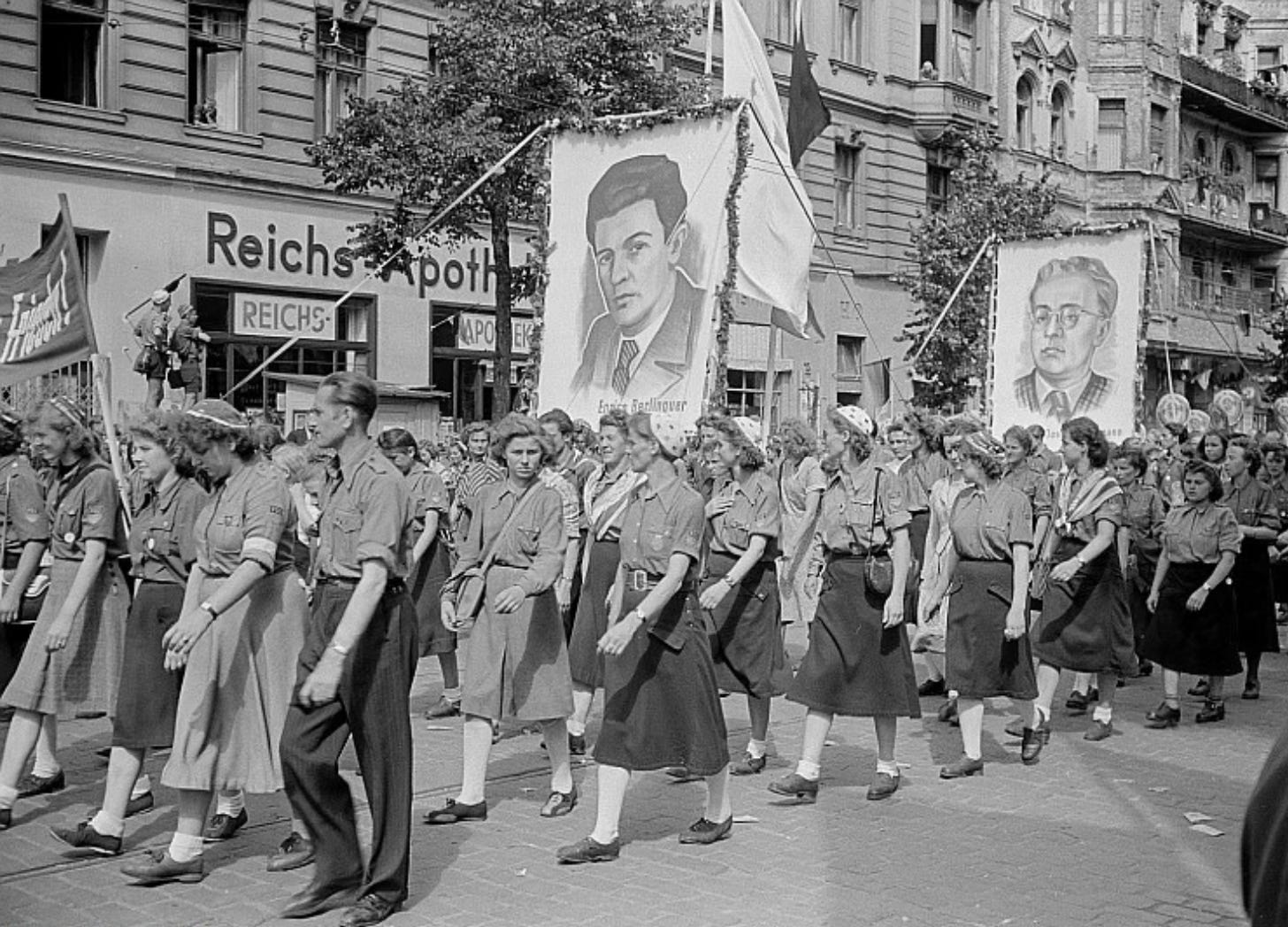

In 1951, the French sociologist and communist Maurice Duverger “wrote the book” on political parties, fittingly called Political Parties. In it, he set out a theory to explain the rise of mass parties based on neighborhood branches:
The branch is a Socialist invention. The Socialist parties which became organized on a purely political basis and direct structure naturally chose it as the fundamental unit in their activities. . . . The choice of the branch by Socialist parties was perfectly natural. They were the first to try and organize the masses, to give them a political education, and to recruit from them the working-class elites. The branch corresponded to this triple requirement. In contrast to the caucus, the middle-class organ of political expression, it seemed the normal organ of political expression for the masses. But these masses did not all accept Socialism: consequently, various middle-class parties tried to attract them in their direction by the very methods that were making the working-class parties so successful. In many countries the parties of the Centre and even of the Right changed their organization and replaced the caucus by the branch as a basic element. Almost all the new parties have followed these tactics, but many old parties as well: this is an interesting example of contagious organization.
Elsewhere in the book, Duverger calls this phenomenon the “contagion from the Left.” Politics was once a game dominated by an oligarchy of rich gentlemen who had little need to appeal, let alone organize, regular people. The political elite instead organized themselves into rival caucuses in legislatures and used these caucuses to fight amongst themselves for power and political spoils. This lasted until labor movements began to win voting rights for the working class. Once workers won the right to vote, socialist parties threw themselves into the task of mobilizing these new voters, and they invented the mass party in the process. Mass socialist parties also gave their activists membership rights in determining party policy and choosing leaders because it was the only way to ensure activists would do the work of building the party at the grassroots.
The elite-ruled, caucus-based political parties of old were at a serious disadvantage compared to this new competitor. Hence other parties, not of the Left, were forced to respond by trying to organize their own mass bases through neighborhood branches. Eventually this also entailed creating more formalized party structures with membership rights for their party activists as well. In other words, the mass party structure spread like a contagion from the Left to the Center and Right.
Contagion From the Left 2.0?
The breakthrough victories of the Democratic Socialists of America in the last two years, powered by a highly active grassroots base, have had me thinking about Duverger’s idea of a contagion from the Left.
Since the 1970s, political parties worldwide have been “hollowed out,” shedding what remained of their internal democratic structures, large activist bases, and neighborhood branches. They increasingly resemble “cartels” of elected officials whose only interest is reelection.1
In the United States, where there was never a strong challenge to the dominant parties from an independent mass working-class party, neither the Democrats nor the Republicans ever fully took the form of a mass party. Nevertheless, they had some aspects of one thanks to their origin in the chaotic and unique mass democratic culture of nineteenth-century America.
In recent years, and following the international trend, the Democrats and Republicans have also undergone the same hollowing out and cartelization as their counterparts in other capitalist democracies. They have returned to the traditional “caucus” party structure which puts almost all power in the hands of a small number of party elites and elected officials in Washington DC.
Caucus-based parties are well suited for a political system dominated by a small oligarchy, as Duverger observed. It makes sense then, that decades into the Neoliberal Era, after the historic defeat of what remained of working-class and other social movements, the Democratic and Republican Parties have regressed to a form that fits the needs of today’s elites.
What makes the moment we’re living in interesting though is that the caucus-based party form is still especially vulnerable to a challenge from below, if one can get off the ground. DSA, today, is the organization that has gone furthest in building that kind of challenge from below, building what is now a de facto mass party.2
Some in the Democratic Party may now be waking up to the problem they face. Tom Suozzi is a representative for one of Long Island’s wealthy congressional districts and a member of the Democratic Party’s pro-business New Democrat faction. After DSA’s string of congressional victories, he told The New York Times:
The bottom line is that you have to give the DSA and you have to give MAGA credit, because they’re organized. And the people that don’t agree with their philosophies wring their hands at cocktail parties, but they’re not organized. So we have to get organized.
I doubt that Suozzi and his friends have a real plan to build a grassroots base. By “get organized,” Suozzi et al. seem to have in mind, for now at least, multimillion-dollar ad campaigns against DSA.
But the string of victories by left-wing politicians against much better-funded corporate Democrats are an encouraging sign that these kinds of ad blitzes are losing their force. And that, potentially, might give us a hint of what is to come. If grassroots muscle continues to beat advertising blitzes from above, at some point the establishment will have to change course. Could that point in the direction of a new kind of political system, built around mass political parties? If it does, that might bring an end to what Anton Jäger calls our era of “hyperpolitics,” when mass political polarization is at an all-time high but regular people have frustratingly little power over the elites who are supposed to represent them.
If history is a guide, whether or not it plays out that way will depend in large part on the success of DSA and other challenges from below. For the time being, though, the cocktail caucus of the Democratic Party is finally sweating, and that could be the first sign that a contagion from the Left is spreading.
On the hollowing out metaphor, see Daniel Schlozman and Sam Rosenfeld’s recent book, The Hollow Parties: The Many Pasts and Disordered Present of American Party Politics. On the cartel party concept, see the work of Peter Mair and Richard Katz.
Of course, DSA also suffers from limitations, the most glaring of which is the fact that its influence is still limited to young, mostly college-educated working-class and middle-class voters in cities. If it can’t break out of that in the near future, its challenge to Democratic elites will be contained.