


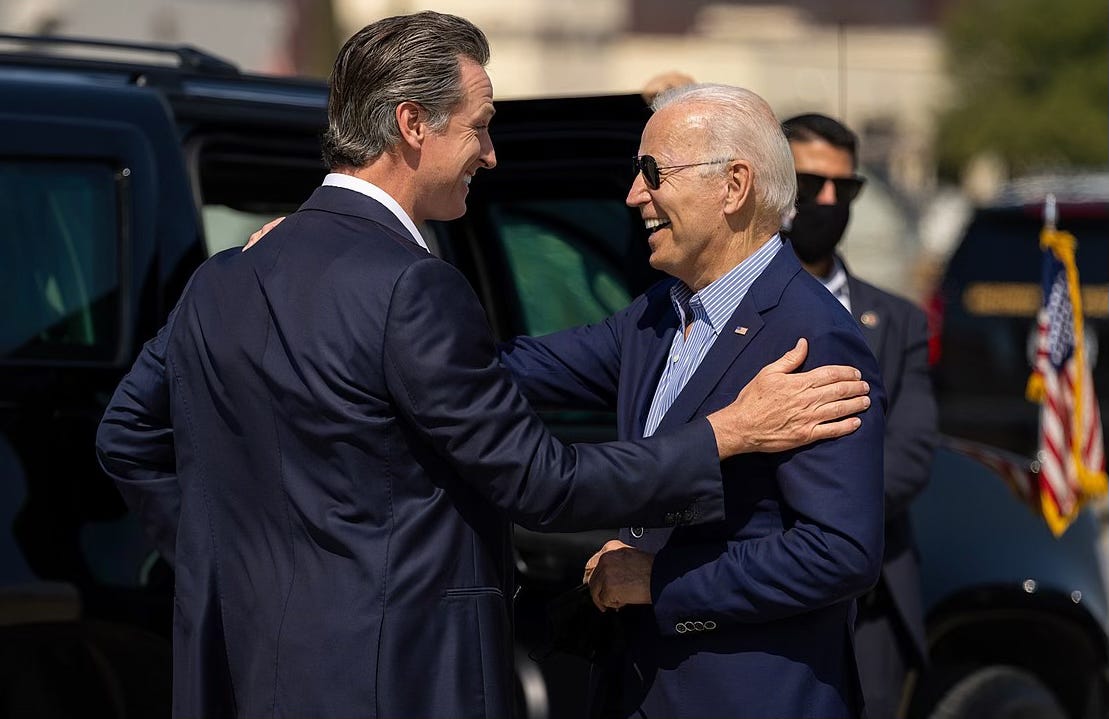
Donald Trump’s approval ratings are falling, and Republicans’ fortunes look increasingly bleak. The betting markets now have Democrats as the favorite for retaking the House this year and winning the presidential election in 2028. (Never mind that they continue to refuse to act as a real opposition party or meaningfully speak to working-class voters’ material interests. It’s their turn to be the lesser evil for a majority of Americans.)
A lot depends on who that president actually is. Most polling shows either Kamala Harris or Gavin Newsom in the top spot for Democratic presidential nominee, with Pete Buttigieg, Alexandria Ocasio-Cortez, and Mark Kelly rounding out the top five. It is possible that AOC wins in 2028, which would create a somewhat distinct set of questions for the left. But it seems at least as likely that, should Democrats recapture the White House, we will have a run-of-the-mill corporate centrist in charge. (I’m making a big assumption here, of course. If Trump and the GOP try to steal the upcoming elections, my question may be moot.)
This raises an important question for socialists and the labor left: If Democrats retake control of Washington, DC, in 2028, how will things be different this time around, compared to the Biden administration?
If Harris, Newsom, and Buttigieg’s own political pasts are any guide, they will be socially liberal without rocking the boat on questions of labor law or economic redistribution. (Check out Newsom’s latest priority: defeating a tax on billionaires in California.) And recent Democratic presidents — and, in fact, the recent history of the Western center left in general — shouldn’t give us much confidence that the next Democratic administration will succeed in enacting the kind of broad reform program that might finally break the far right.
If that’s so, how should labor and the Left relate to a corporate-centrist Democratic administration? The experience of the Biden presidency may be instructive.
Joe Biden was, to many observers’ surprise, relatively ambitious in his economic policies: he championed a major (though ultimately temporary) expansion of the welfare state and significant investments in green energy; he also made the unprecedented-for-a-president move of supporting striking workers on the picket line. Yet even his policy ambitions were very modest by historical standards. He was hemmed in most importantly by what he thought would be acceptable to corporate donors and capital, and when he encountered conservative opposition from within his own party, he retreated rather than using his policy leverage or taking those forces on in primary elections. Worst of all, his decision to back Israeli war crimes to the hilt was morally monstrous and predictably alienated many supporters.
By the end of his four years, Biden was an unpopular president who oversaw both a high-inflation economy at home and a genocide abroad. Yet many on the left and in the labor movement were sympathetic to his administration and even defended it as a “break with neoliberalism.” But a half-heartedly “populist” administration — with one foot in the wonky world of progressive policy NGOs and one foot in the corporate Democratic establishment swamp, and infrequently giving a hat tip to labor — was never going to be any match for rising MAGA authoritarianism.
As I have argued in Left Notes previously, what we need to combat the pathologies that feed the far right is a society-changing reorganization of the American economy and a major revitalization of the labor movement. If Biden gave the occasional nod in that direction, there was never any real prospect that he would lead the way in that kind of project. Nor do the prospects for that seem brighter under a President Kamala Harris or a President Gavin Newsom in 2029.
It’s true that a Democratic president would bring a respite from the worst illiberal, antidemocratic, and anti-labor horrors of GOP rule, and that alone is enough reason to welcome one. But the left needs to ask itself how it will use that breathing room to actually build up the labor movement and to construct an organized political alternative free of the baggage of the national Democratic Party brand. And how to do that while opposing a president who will inevitably turn on the party’s own voters — something that the left didn’t do forcefully enough under Biden. That conversation about how to avoid repeating past mistakes needs to start now.
While I know you didn't intend to do so, your post feels to me rather like you are conceding that Gavin or Harris will be the nominee. God help us, if so. In the end, another round of neo-liberalism will just reinforce the forces of fascism.
We cannot waste energy carrying water for Biden 2.0.