


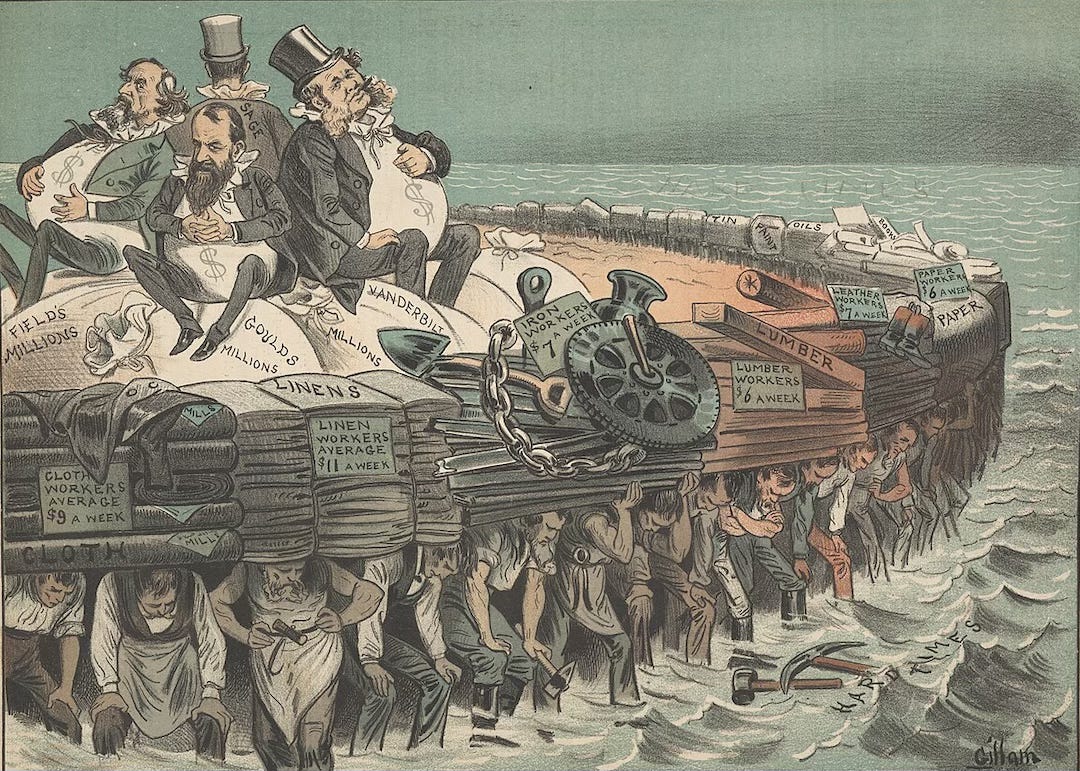
In the 1980s, the leading analytical Marxists debating the nature of exploitation settled on what I call the Distributive Injustice View: the idea that exploitation occurs when person A benefits from person B’s uncompensated labor as the result of an unjust inequality in the distribution of productive assets. In my first post in this series, I explained the arguments for the Distributive Injustice View as well as some shortcomings.
In the last decade and a half, however, the Domination View has emerged as a prominent competitor. Its most systematic philosophical proponent is Nicholas Vrousalis. This account of exploitation has gained ground at the same time as a new crop of socialist writers have emphasized the centrality of domination to classical critiques of capitalism. William Clare Roberts and Bruno Leipold, for instance, have argued that the republican tradition in political philosophy, focused on combating relations of domination, was a crucial element in Karl Marx’s thought; meanwhile, Alex Gourevitch has sought to recover the thought of the “labor republicans” of the early nineteenth- and twentieth-century United States, who like Marx channeled traditional republican opposition to domination into an anti-capitalist creed.
Here I lay out Vrousalis’s version of the Domination View, its apparent advantages over rivals, and what I see as some of its biggest problems.
The Domination View
The Domination View focuses on the idea that exploiters take advantage of some vulnerability of those whom they exploit. Not just any way of taking advantage of another’s vulnerability is exploitative, of course. If I forget to pack my lunch, the halal cart vendor near my office can, in a sense, take advantage of my vulnerability: they might profit from my need for food. But it is hard to believe this means the halal guy exploits me when I fork over $10 for chicken shawarma.1 So the Domination View must be more specific about the sort of vulnerability involved in wrongful exploitation.
The key is that exploiters take advantage of exploitees’ vulnerability by (you guessed it) dominating them. But what is domination? It is typically glossed in the philosophical literature as being subjected to another’s arbitrary will. In this vein, Vrousalis characterizes domination as “subjection of purposiveness to the (arbitrary) choices of others.” Basically, domination is when one person (or group) exerts control over another’s agency, without consideration for the latter’s interest or will.
In the specific context of the workplace, he defines domination with the Non-Servitude Proviso (NSP): “For any agents or groups engaged in mandatory mutually affecting cooperation under a division of labour, and barring any special justification that exempts them, none should possess unilateral control over the labour capacity of any other.” Domination occurs when the NSP is violated.
Importantly, Vrousalis does not provide a general theory of domination, nor does he say what, exactly, it means for one agent to have “unilateral control” over another’s labor capacity. The general idea seems to be that dominating agents have a kind of power over the dominated that the dominated do not have over the dominators. Vrousalis argues that the NSP is compatible with a range of views of what domination consists in. More on this below; the devil is in the details when it comes to specifying what domination really is.
Still, the overall shape of Vrousalis’s Domination View is clear enough: Capitalism is exploitative because capitalists’ ownership of the means of production, and workers’ lack of it, grants capitalists control over workers’ productive agency, which capitalists then use to extract uncompensated labor.
We can see how the Domination View seeks to avoid the problems of the Force and Distributive Injustice views (see the first post for a refresher on the Force View):
Unlike the Force View, the Domination View need not imply that taxing workers to pay for welfare benefits is exploitative, since plausibly, in a democratic society, the state does not extract income from its working population by way of control over their labor.
The Domination View also has resources to explain why capitalists might still exploit workers even in the presence of a generous welfare state. Although such a society might not force workers into the labor market, capitalists’ monopoly over the means of production, and workers’ desire for income above the state-provided minimum, creates a power imbalance whereby capitalists are able to control workers’ productive agency and extract uncompensated labor.
Unlike the Distributive Injustice View, the Domination View does not say that exploitation depends on an unjust prior distribution of means of production. So it can condemn the prospect of “cleanly generated capitalism” as well as scenarios like Desert Desperation (again, see the first post for more on this).
By the same token, the Domination View allows us to say that capitalism’s distribution of means of production is unjust because it enables capitalist exploitation of workers.
The Trouble With Domination
At first glance, then, the Domination View looks like an advance over rival accounts of exploitation. But its success depends on how we spell out the underlying notion of domination and fill in the details of the NSP. As noted above, the NSP itself is quite abstract. And Vrousalis does not specify what makes “mutually affecting cooperation” mandatory, nor what sorts of considerations justify special exemptions to the proviso.2
There is a potentially fatal problem looming here. Philosophers have observed that some definitions of domination end up making domination look unavoidable or inescapable; that is, they define domination in such a way that no plausible social arrangements could prevent us from being dominated. This is sometimes called the problem of “cheap domination.”3 The cheap domination problem should worry socialists, because, if domination is not the kind of moral ill that can be overcome by democratizing the state and the economy — if workers would still be dominated even under a plausible version of socialism — then it follows that they may still be exploited under socialism. In which case the Domination View would not give us a strong critique of capitalism after all.
An Overly Demanding Conception of Exploitation
Even though Vrousalis does not provide an explicit account of domination, the practical conclusions he draws from the Domination View should give us pause. They suggest that his implicit understanding of domination leads him to a conception of exploitation that is too demanding — it condemns certain transactions as exploitative when they actually aren’t.
To see this, first consider the following scenario discussed by Vrousalis.
Horizontal: There are two cooperatives, Robinson Inc. [A] and Friday Inc. [B], trading only in final goods. Each firm has five employees and is operated democratically. [A] is capital-rich, [B] is capital-poor. The economy-wide net product is worth $80 [and an hour of labor on average produces $1 of product]. . . . Each member of the [A] coop works 4 hours and receives 8 hours of labour time (expressed in her individual income of $8), while each member of the [B] coop works 12 hours and consumes 8 hours (expressed in her individual income of $8).4
So long as there are no differences in how hard the workers in each firm work, or how skilled or knowledgeable they are, etc., Vrousalis says the workers of co-op A dominate and thereby exploit the workers of co-op B here. It is far from obvious to me why that should be. The idea seems to be that co-op A’s greater efficiency gets co-op B’s workers to work extra hours for the benefit of co-op A’s workers. In any case, the more general implication of Horizontal is that capital-rich firms exploit capital-poor firms when the firms are doing business with one another and workers at the capital-rich firm receive higher wages than workers at the capital-poor firm — even if both firms are democratically, collectively managed by their workers and the interfirm transactions are fully voluntary and conducted against a fair prior distribution.5 This result rules out many visions of market socialism as exploitative — for instance, the worker-management-based models of David Schweickart and Mike Beggs.6
But the Domination View has other, maybe even less attractive implications. Suppose some workers at co-op A are more talented or skilled or knowledgeable than others workers who also work at co-op A and use their advantage to bargain for higher wages than less-skilled coworkers; the more-skilled workers then have to work fewer hours to make the same take-home pay as their less-skilled counterparts.
Vrousalis’s Domination View says that these better-paid workers constitute a “labor epistocracy” (an epistocracy is a system where the ruling elite are the most knowledgeable or skilled) who dominate and thereby exploit their less-skilled coworkers. And again, this will be true even if the prior distribution of assets is fair, and everyone’s consent to the wage structure is fully voluntary. Here too, it is far from obvious to me that we should see these transactions as exploitative. This result also implies that most models of market socialism permit exploitation.
What’s going on here? My read is that Vrousalis thinks that pretty much any differential in bargaining power — whether due to physical capital assets or superior talents or knowledge or skills — can be a basis for domination.7 And if person A uses their bargaining-power advantage to get person B to agree to a transaction that involves B working more than A, then A is exploiting B.8
Again, I think this account of domination, and the resulting view of exploitation, is far too expansive. Remember, we started out by asking how to understand the traditional Marxist claim that capitalists, in virtue of their control of the means of production, exploit workers. The Domination View does offer an explanation of that claim. But it also implies that all other sorts of economic transactions are exploitative too: including voluntary transactions both between and within democratically managed co-ops that result in ordinary pay differentials among workers.
My sense, then, is that Vrousalis took a wrong turn somewhere. He is right, I think, to focus on unequal power relations between an exploiter and the exploited, rather than the presence of force (as the Force View does) or prior unfairness in the distribution of the means of production (as the Distributive Injustice View does). But an implausible underlying conception of domination leads his Domination View to unattractive conclusions.
At this point, then, I see two potentially promising directions for exploitation theory. The first is to try to save the Domination View by spelling out a better account of what domination is — an account that would not generate an overly demanding definition of exploitation. The second is to jettison the Domination View and start over, but without abandoning that theory’s emphasis on unequal power relations. But exploring these possibilities is a task for other articles.
Compare Richard Arneson, “Exploitation, Domination, Competitive Markets, and Unfair Division.”
In their reviews of Vrousalis’s Exploitation and Domination, Benjamin Ferguson & Roberto Veneziani and Callum Zavos MacRae offer insightful criticism along these lines.
To put some meat on the bones of the NSP, we might try to draw on other philosophers’ more developed theories of domination. These theories come in a variety of flavors — so-called neo-republican, Kantian, and recognitional — and Vrousalis says that the Domination View is in principle compatible with all of them. (Though he appears to reject neo-republicanism in more recent work: see “What Is the Wrong of Capitalism? A Reply to Chiara Cordelli.”)
I’ll just say here that the contemporary theories I’ve seen in the literature don’t inspire a lot of confidence. In particular, the most prominent accounts — including Philip Pettit’s influential neo-republican conception of domination, and Arthur Ripstein’s Kantian theory — seem ill-suited to explaining how democratizing political and economic power, as socialists advocate, would actually reduce or eliminate domination. In other words, they are subject to something like the problem of cheap domination discussed in the main text. (See Niko Kolodny, “Being Under the Power of Others” and The Pecking Order for convincing arguments to this effect.) That more fundamental problem aside, it should also be noted that neither Pettit nor Ripstein think their views imply anti-capitalist conclusions, though they could of course be wrong about what their theories entail.
See, e.g., Christopher McCammon, “Domination: A Rethinking.” As McCammon puts it: “Domination is supposed to be morally serious. If an account of domination says that many ordinary, innocuous human interactions instantiate domination, that’s a reason to reject it — at least as an account of what the dominated have reason to complain about.”
Exploitation as Domination, p. 136
Remember: Vrousalis denies that either force or an unfair prior distribution of assets is necessary for exploitation.
Schweickart, Against Capitalism; Beggs, “The Market and Workplace in Democratic Socialism.” The latter model is developed at more length in Beggs’s forthcoming book with Bhaskar Sunkara and Ben Burgis, The Blueprint. Vrousalis explicitly charges Schweickart’s model with allowing this kind of exploitation.
To be clear, I’m not saying that all interfirm wage inequalities due to inequalities in capital assets are justified or morally innocuous. There are good reasons to try to keep wage inequalities from getting too big, whatever their origin. But Vrousalis’s Domination View implies that all inequalities of this type specifically involve the unjust exploitation of poorer firms’ workers by richer firms’, which seems to me too strong a claim.
Differences in preferences on their own wouldn’t amount to problematic differentials in bargaining power, according to Vrousalis’s view. To adapt an example of Phillipe Van Parijs’s, also discussed by Vrousalis: If Crazy really likes working a lot and Lazy prefers working very little. Suppose Crazy and Lazy are equally endowed with capital and skills, talents, etc. and start a two-person co-op. If they come to a fully voluntary agreement that Crazy works 7 hours a week, Lazy works 1, and they split the profits evenly, the Domination View would not say this transaction is exploitative.
Ferguson and Veneziani, in their review of Exploitation as Domination, express puzzlement over Vrousalis’s claim that Horizontal is exploitative; they suggest he is forgetting his own view that unequal labor exchange is insufficient for exploitation and also requires domination. I think that is an uncharitable reading of the text. I interpret Vrousalis as holding that co-op A’s advantage in capital assets over co-op B itself constitutes domination and so enables A to exploit B.
The domination occurs after the labor transaction has already been finalized. You agree to a work arrangement for X dollars. No domination has occurred, yet. It first arises when your boss asks you to do something, and then you have to ask yourself, “what happens if I say no?” If the answer is “then I may get fired, demoted, or otherwise punished, without any recourse to fair procedures and negotiated agreements which reflect the interests of all parties involved” then you are being dominated.
This artwork is so cool. I’m new here. Are you the artist?