


There’s a lot of excitement about and interest in the leftward movement of the Democratic Party base. I think it is very much a real development. The election of Zohran Mamdani, the mass turnout for the No Kings protests over the last year, and the growing majority of Democrats supporting progressive economic positions and Palestine all suggest as much.
But much less attention has been given to the shifting composition of the congressional Democratic Party, and here the story actually runs in the other direction. As of 2025, a majority of House Democrats now belong to the party’s center-right caucus, the New Democrat Coalition (NDC).
New Democrats owe much of their strength to their rapid growth between 2015 and 2019, when the caucus grew from a quarter to close to half of the party’s congressional membership. The combination of the anti-Trump swing among center-right Republicans and the party’s own strenuous efforts to put down roots in suburban America (a development I wrote more about in Catalyst last year; for a short summary see here) in these years no doubt helped reconfigure the congressional party.
But until last year, New Democrats were about evenly balanced with their counterpart on the party’s center left, the Congressional Progressive Caucus (CPC). It was only after the 2024 elections that New Democrats emerged as the majority faction in the party, while the Progressives shrunk.
Digging Into the Numbers
Membership in Congress’s ideological caucuses should be taken with a grain of salt. Congressmembers often join these caucuses less out of an ideological commitment and more as a means to boost their reputation with party activists in their home districts. That’s also why a decent number of Democratic members of Congress, for example, belong both to the CPC and the NDC (based on the most recent membership lists, thirty-one House Democrats are members of both caucuses).
So, to get a better sense of the balance of power in the congressional party and how it’s changed, I pulled lists of caucus membership from 2026 and from this time eight years ago in 2018, at a similar point in a Donald Trump presidency, plus 2009. I also pulled lists of the even more conservative Blue Dogs caucus. The majority of Blue Dogs are also NDC members; to adequately capture the strength of the ideological right of the party, the Blue Dogs who are not dual members should also be included as being on the right. Finally, I pulled lists of cosponsors of Medicare for All (M4A) from 2009, 2018, and 2026.
I divided Democrats into five groups based on caucus membership and whether they support Medicare for All. The following table describes each group. The use of the “left” and “right” labels here, of course, are meaningful only in the sense of describing where Democratic congressmembers fall relative to each other.
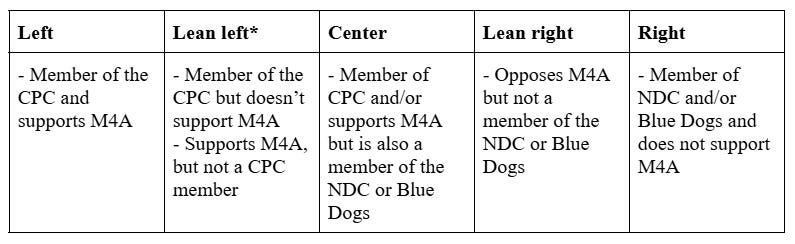
(* Note that lean left excludes any member who is also a New Democrat or Blue Dog.)
As you can see in the following charts, Democrats shifted to the left between 2009 and 2018. Part of that is due to the defeat of a number of House Democrats in more conservative districts beginning in 2010. But that isn’t the whole story, and the change aligns with my own sense of bigger trends happening in these years too.
Between 2016 and 2018, for example, there was a real uptick in support for Medicare for All in Congress — the number of cosponsors grew from sixty-three in 2016 to an all-time high of 125 in 2018. Remember too in the lead-up to the 2020 presidential election there was a brief moment when many of the party’s presidential contenders were speaking favorably about Medicare for All. The depth of that commitment was shallow, as the quick retreat beat by Kamala Harris, Cory Booker, and Elizabeth Warren demonstrated. But there was certainly something in the air, which helped feed a more progressive start to Joe Biden’s administration than many anticipated.
By contrast, between 2018 and 2026, the party has moved significantly away from the left. While the proportion of congressmembers on the congressional party’s left flank has shrunk only slightly, the proportion of House Democrats who lean to the left has shrunk dramatically. That has led to a significant uptick in the number of members in the center, but it has also involved a considerable rebound in the size of the more ideologically consistent right flank of the party. While the left + leans left group made up about 36 percent of the congressional party in 2009 before growing to 55 percent in 2018, it has shrunk considerably since then to around 37 percent.
The especially strong drop-off in the proportion of left-leaning House Democrats suggests that what we’re really seeing here is a collapse in the “fair weather friends” demographic in the congressional party. Interestingly, that drop-off isn’t being driven by a shift in the politics of the party’s base. The base, as I alluded to above, seems to be moving leftward. Nor can it be read as a simple reaction to Democrats’ defeat in 2024. The charts compare where things stood in March 2026 to March 2018. In both cases, that’s about fifteen months after a bruising defeat to Donald Trump and the GOP. The contrast with the leftward shift between 2009 and 2018 underscores that the momentum is headed in the opposite direction this time around.
Many caveats are in order. How many members of Congress who cosponsor Medicare for All would actually vote for it if it stood a chance of passing? I’d wager only a small fraction of the official list of supporters. A definition of being “on the left” that only considers CPC membership and support for M4A is also painfully limited — a more detailed analysis should consider members’ positions on arming Israel, regulating the finance industry, and so on. (Check out this spreadsheet by DSA comrades for a lot more detail on where members of Congress stand.)
In an ideal world, there would be more than two parties in Congress, and/or ideological caucuses would have more meaning and greater discipline. It’s one of the real scandals of American “democracy” that all politicians think that they should represent their own idiosyncratic blend of policy positions. It makes it exceedingly difficult for people outside of DC politics to get a sense of what is actually going on and to hold different political programs and their supporters accountable. (That’s one reason why having a multiparty system is an indispensable component of a more robustly democratic system.) But we work with the hand we’re dealt and the information we have available. As a first pass for trying to assess where things stand in the congressional Democratic Party, I think the exercise is still useful.
And so . . . ?
What comes next will matter a great deal for what happens in 2029, should Republicans lose the next presidential election. What kind of Democratic Party will take the reins in the future? The way things are headed now, it looks like it’ll be a party whose politics resemble those of Bill Clinton much more than they did in 2021.
For the left and the labor movement, that’s worth factoring in as we think about the years to come — though the shape of things to come is also in our hands to help mold. No one should operate under the illusion that the congressional Democratic Party is undergoing some kind of progressive realignment so far, regardless of where the party’s base is at. Democratic members of Congress are headed in the other direction.
But that could also open up a new opportunity for a much more aggressive intervention in congressional politics. To date, the left has focused primarily on state and local races. But because congressional Democrats are so out of step with their base and that appears to be increasingly the case, the time is ripe for a more concerted jump into the national arena.
This is important information. Thank you, Neal.
Taking this onboard, I wonder, how does the party-wide congressional pattern you mention, look if restricted to the few congressional seats where Republicans tend to compete credibly with Democrats at general elections? That is, what do these patterns look like in "swing" districts? Or for that matter, "lean" districts? As compared with one-party congressional districts where DSA and other left-liberal activists typically self-confine?